
Whether in print or online, perusing colorful garden catalogues in the cold winter is often more exciting than window shopping at a department store. The possibilities of color, taste and variety are almost endless. However, so are the unfounded claims. When the real work starts, those claims of incredible harvests, color, taste, plant vigor and consistency all wrapped into that packet of seeds can turn out to be at least exaggerated, if not outright false.


If you happened to catch my post about my trial of greenhouse parthenocarpic cucumbers (cucumbers that produce fruit without pollination), you may already know that not all cucumber varieties that are listed as parthenocarpic by the seedsman are as advertised – especially if the variety is open-pollinated (non-hybrid). There may be a number of reasons for this discrepancy, but because of previous experiences with incorrect descriptions, I decided to take things into my own hands. My choice to not trust the variety description let me to trial a group of open-pollinated cucumbers that had been touted as being parthenocarpic. At the end of the trial, one of the most promising trial varieties that demonstrated a high percentage of parthenocarpic traits was the China Jade.


The China Jade is a long dark-green spined Asian cucumber variety that tends to stay on the vine for a long period of time without having fruit abort. While a few fruit may begin to yellow and wither, the China Jade tends to let the female flowers remain on the vine long enough for the majority to set fruit – regardless of whether they have been pollinated or not.

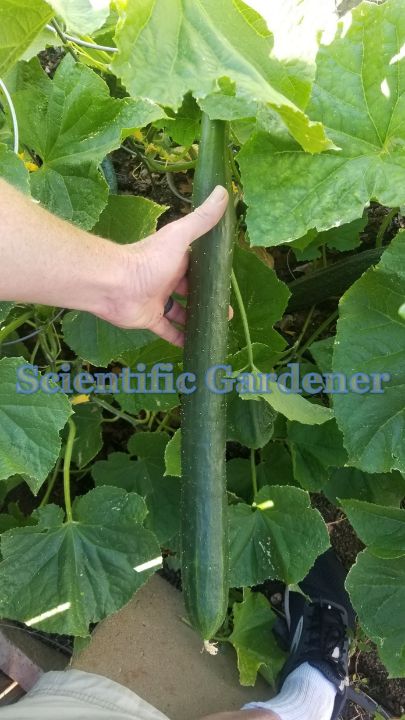

While China Jade has some very good traits (long fruit, desirable flavor and parthenocarpic fruit set) it also has some challenges. The vines suffer somewhat from brittle stems - a trait that I have seen in some modern Cucumis sativus cultivars. Additionally, the fruit tends to be very flexuous – bending and curving quite a bit. To alleviate the severity of bending, the fruit can be staked or trellised so that the fruit hang down, but this does not completely solve the problem. If allowed to remain on the vine, my experience was that well over 10% of the fruit were so twisted that they would be completely unmarketable. Even after trellising, the gardener may want to walk through the cucumber vines twice each week to snap off all the highly twisted fruit that are beginning to set.


Overall, I would say that those hoping to find a long Asian variety that could possibly produce well in the greenhouse, the China Jade may be the variety for you. However, even parthenocarpic varieties are more productive and grow more marketable fruit when pollinated – so growing them in an area with pollinators is still preferred.


The vines of China Jade produce many crops of fruit and the vines could likely be pruned and trellised in greenhouse conditions. Additionally, the fruit is mostly gynoecious, meaning that they produce mostly female flowers. This decreases the amount of energy the plant is putting into producing male flowers and increasing overall yield.


Throughout the course of the season, I was greatly impressed by this variety’s staying power. It kept pumping out the fruit long after other varieties no longer produced.


My overall thoughts about the China Jade is that it is fantastic for production, disease and staying power, but has brittle stems, requires trellising and removing of unmarketable fruit.


